
She lived another 20 years before dying in her own bed
Submitted by: Stacy, Southfield
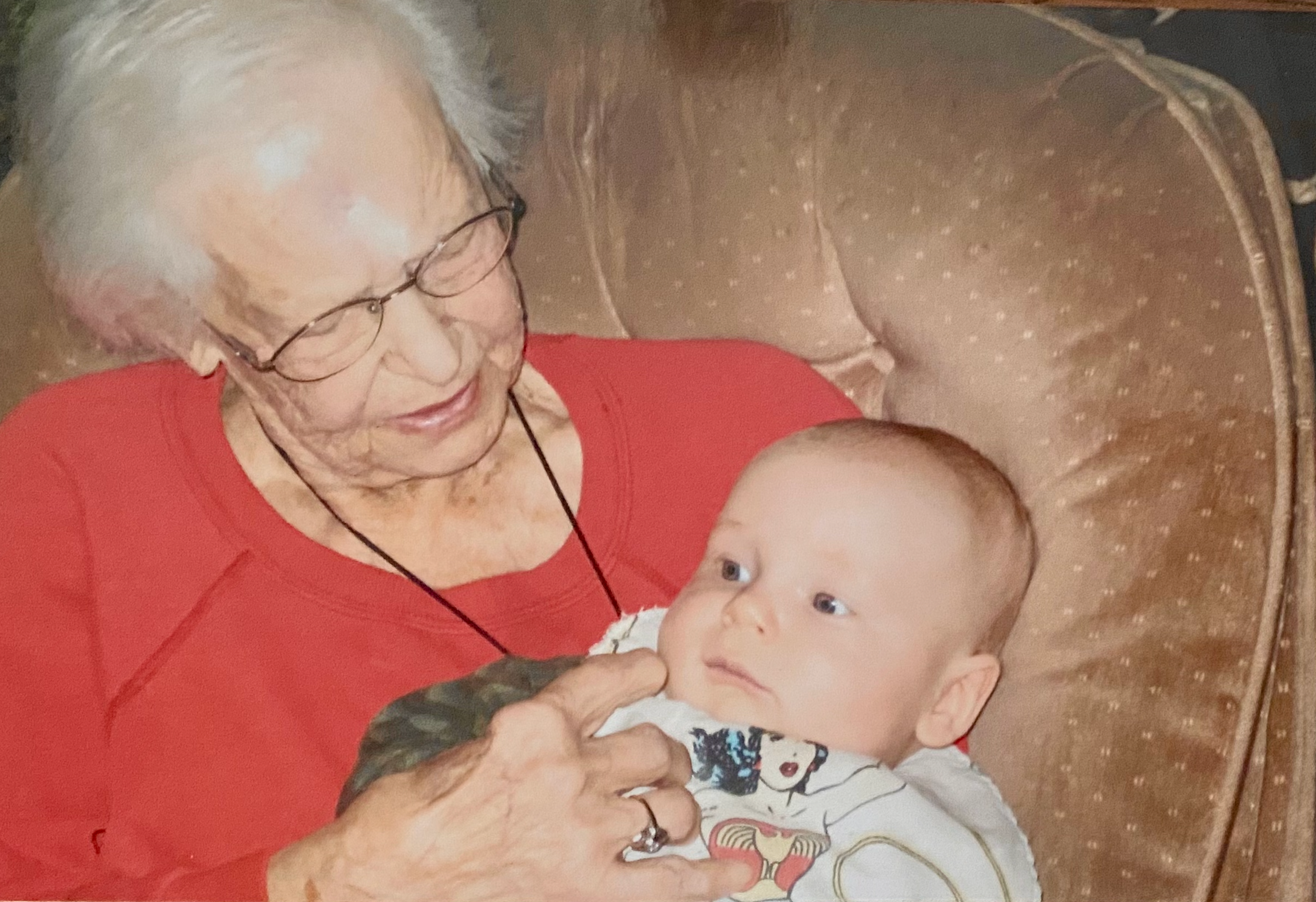
Grandma Mary and her great grandson. An age difference of 100 years.
Grandma was getting older, her heart wasn’t so good, and she couldn’t keep living by herself. She lived way up north on the farm, and in the winter, the county sometimes didn’t plow the dirt road in front of her house for days after a bad snow storm. Not only that, even if the road were plowed, who would plow the long driveway? For a while she came down to The City to live with my dad every winter, in his small ranch in Plymouth. That was what she called it, “The City.” She meant anything south of Flint. She had lived in The City when she was a young woman, actually in Detroit. She had worked at the big Hudson’s department store downtown for a while, and even on the assembly line with the other women during the war. But she spent most of her life as a farmer’s wife, and more than that, she was a farmer too.
The truth was, my grandfather wasn’t much of a farmer. I don’t remember Grandpa ever doing much besides sitting in his big easy chair. The baseball game was on the TV, and his chair pointed in that direction. Was he watching? Was he rooting for the Tigers? Or was he just waiting for time to pass? “Dad, dinner’s on!” Grandma called. She always called him “Dad,” which I thought was weird, because to me, “Dad” was his son, my father. Why didn’t she call him “Husband,” or by his name, “Pete?” I didn’t know. My grandfather’s name was Peter Paul, and my grandmother was Mary. “Dad!” she called, and he slowly reached for the metal walker next to his big chair. Then he slowly pulled himself up, and slowly walked, one shuffle step at a time, to the table. As he walked, his back was bent almost as much as when he was sitting in that chair. He sat at the head of the table.
“Blessusohlordandthesegiftswhichweareabouttoreceivefromthybountythrough christourlordfathersonholyspiritamen,” said Grandma in one long breath. Grandpa said nothing, but ate the roast beef with potatoes and the cucumber salad dressed with sour cream she served. Grandpa died in 1988, when I was in 8th grade. Shortly after that, Grandma started spending winters with my dad.
I didn’t know then that Grandpa had Multiple Sclerosis. I didn’t know that for many years Grandma had not just made the meals and kept the house clean, the chores of the farmer’s wife, but taken care of her husband, all the while she had to milk the cows and run the farm herself. I learned those things later, from my dad, the farmer’s son who never wanted to be a farmer. He didn’t have many good things to say about his own dad, but he respected and loved his mother.
So when Grandma’s heart started acting up, Dad was worried about her. She was having episodes of chest pains, shortness of breath, and a racing heartbeat. Dad knew she needed him. At about the same time, my dad had come to a crossroads in his career. The Detroit branch of his office was closing. He could move to Chicago and stay with the same job, or take a buyout. With two small kids living nearby with his ex-wife and an aging parent who needed him, he chose to walk away from his career in order to stay in Michigan.
My dad sold his house in Plymouth and moved back home to the family farm up north in Bentley, Michigan, to live with his ailing mother for the last few months of her life. Dad told me later that he wanted her to live comfortably in her own home till the end of her life, and then he planned to move back to the City and restart his career.
What Dad didn’t know then is that those chest pains Grandma kept having were not mini heart attacks. They were panic attacks. Grandma’s heart was fine. In fact, it was better than fine. Grandma’s heart was as strong as an ox. She lived another 20 years before dying in her own bed. My dad lived with her on the farm in Bentley as the months became years and then decades, as she got older and frailer and sicker. My grandmother lived to the age of 105. My dad was her caretaker.
In the beginning, Grandma didn’t need that much help. She needed help with plowing the snow and mowing the lawn, yes, but she still drove her Oldsmobile to church in town every Sunday, and she still cooked roast beef with potatoes and carrots, and made her cucumber salad with sour cream. Gradually, my dad took over a little more of the housework. Well, let’s be honest, Dad wasn’t much of a housekeeper. What really happened is that the house got dirtier and stayed dirty except for the center of the floor where Dad vacuumed. Luckily for them both, my Dad was a good cook. He could make a fine roast beef. Eventually he even learned to make pancakes without setting off the sensitive smoke detector in Grandma’s kitchen.
Unfortunately, there weren’t many good jobs for Dad up north. He tried selling cars, but that didn’t bring in much money. The money from his buyout ran out. The money from selling his house in Plymouth ran out. Grandma had saved some money, but she had imagined she might need enough to live to 80. Decades beyond that, her savings ran out, too. They put a second mortgage on the farmhouse and lived on that until that also ran out. She got a little money from Social Security. A very little. It wasn’t enough to do things like replace the roof, which got worse every year, or fix the upstairs toilet. When it broke, they just closed the door and stopped using the upstairs bathroom.
When Grandma fell and broke her hip, everyone thought that would be the end. But it wasn’t. She came through the surgery well. She sat in her wheelchair facing the television. The Tigers were on. Was she watching? I don’t know.
Towards the end of her life, Grandma lost most of her hearing, most of her sight, and most of her memory. Sometimes I would call the house and Grandma would answer. They had a landline phone. (In fact, it was a party line. That meant that if one of the neighbors was using their phone, Grandma’s would ring “busy.”) If Grandma answered, the conversation might go like this:
Me: Hi Grandma! How are you!?
Grandma: Who’s this?
Me: It’s me! Stacy!
Grandma: Who??
Me: STACY!! Is Dad there? Can you put him on?
Grandma: WHO???
Me: Nevermind, Grandma, I’ll call back later. Goodbye.
After a while, Grandma needed more help than Dad could give her. She needed someone to stay with her during the day, while he was at work trying to sell cars. Somehow, Grandma was enrolled in a pilot program that paid for a home health worker. One of the first women who came to stay all day with Grandma was named Melissa, and went by the nickname Missy. She would fix Grandma a sandwich and bring it to her as she sat watching The Price Is Right. She would give Grandma her pills, including what Dad called her “relaxing pills,” that took care of the panic attacks. And she would wheel her into the bathroom where she would bathe her and change her adult diaper. Missy was just the first of many, but Grandma couldn’t remember the names of the others, and for many years afterwards she called all her home health care workers “Missy.”
There was always a worker who stayed with Grandma in the daytime, while Dad was working, but he was on call all night long. Towards the end of her life, Grandma’s sleep schedule resembled a newborn’s: she slept and woke in short bursts all around the clock. It was exhausting for him because he couldn’t leave her alone. He loved to go hunting, but he didn’t dare hunt further than the treelot in his own backyard, where he was still in earshot if she needed anything. He built three deer stands back there, and sat up in them with his rifle, waiting for the deer to walk past on their way to nibble on the neighbor’s cornfield. Until Grandma needed him again.
One hot summer weekend, I brought my four year old son up from The City to the farm for his first camping experience. My son was born in 2009, which made the age gap between him and Grandma a full 100 full years. I pitched a tent in Grandma’s big back yard, close enough to the trees behind the house to feel like we were out in nature, but close enough to go inside if the coyotes spooked us. Dad, who loved camping, slept outside with his daughter and grandson. He had promised to make us pancakes and sausage links for breakfast. In the middle of the night, a pale figure in a long white gown appeared at the back door of the house.
“Gary! Gaaaarrrrrrryyyyyyyy!” she called.
I was half asleep and thought I was seeing a ghost. But my dad, very accustomed to this midnight apparition, was out of the tent and escorting his mother back into the house before my sleepy brain understood what was happening.
In addition to being physically exhausting, caring for Grandma was emotionally exhausting. Long after she stopped recognizing the home health workers who were taking care of her, after she stopped recognizing her great-grandson, after she stopped recognizing me, she always knew my father. He was always there for her. But she wasn’t always 100% quite there herself. He would sometimes humor her when she seemed confused. I remember one conversation I overheard between them, as Grandma sat in her old chair facing the television, and my Dad sat nearby on the couch.
Grandma: I want to go home.
Dad: Sure, mom, get your purse, let’s go.
Grandma: I want to go home.
Dad: You bet. Get in the car and tell me where to take you. I’ll drop you off.
My dad had dedicated so many years of his life to living with and taking care of her so that she never had to leave her home and live in a nursing home and could die in her own home. And here she was, no longer able to recognize that she was, in fact, home.
Grandma did die in her own bed, of a heart attack, at the age of 105, in 2014. Dad sold the farmhouse. He couldn’t afford to fix it up, and without Grandma’s Social Security check, he couldn’t afford to keep it. I asked him if he would miss the woods behind the house that he had spent so much time in. He told me that he had spent enough time there for several lifetimes and he couldn’t wait to go hunting somewhere else for a change.
By then he was too old to start over in the city. He bought a much smaller house a little further up north, in Beaverton. After all those years of living in his mother’s house, he finally had his own place again. He started to make friends with his new neighbors. He planted a garden. He lured a couple of feral cats into his house and named them Miss Molly and William. He was in his seventies, but he knew that people in his family might live a long time, and he was looking forward to his retirement.
Within three years he was too sick to live alone. I became my Dad’s main caretaker in 2017. But that’s another story.